
Femto-LASIK: Gentle and precise
As an experienced chief physician at the LaserZentrum Wiesbaden and expert in Femto-LASIK, Beate Steinhorst will be happy to advise you comprehensively on this topic.
Femto-LASIK the gold standard
Short operation time of only 60 seconds
Highest precision thanks to femtosecond laser
Uniform and thinner corneal flaps
Further development of the LASIK method
Femto-LASIK at LZW: accurate to the hundredth of a millimeter, gentle on your eye
At LZW, we primarily focus on Femto-LASIK, the further development of classic LASIK. A femtosecond laser forms the flap, a wafer-thin corneal flap: contact-free, without mechanical pressure, and absolutely uniformly.
Its advantages: highest precision, no blade, a procedure that most people hardly feel, and a method that also masters difficult calluses.

How does Femto-LASIK work?
Step 1: The femtosecond laser shapes the flap.
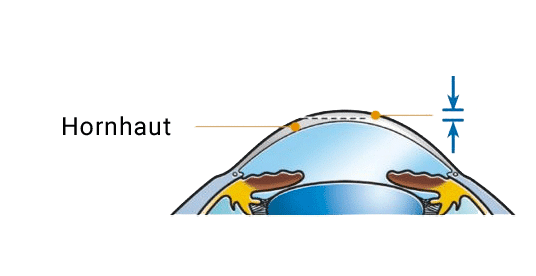
First, a thin flap is created in the cornea. This is done by the femtosecond laser: its ultrashort light pulses act just below the corneal surface and shape the flap with hundredth-of-a-millimeter precision. Then we fold it to the side. Now the LASIK procedure can begin.
Step 2: First flap, then LASIK
Once the flap is in place, the actual LASIK procedure begins, identical for both femtosecond and classic LASIK: The excimer laser removes corneal tissue in the micrometer range, reshapes the cornea, and thus corrects your refractive error. Afterward, we reposition the flap. It reapplies on its own and protects the treated area like a natural bandage. Thanks to the numbing drops, most patients tolerate the procedure well.
Step 3: The excimer laser corrects your cornea
Now the laser precisely alters the corneal curvature according to your individual diagnosis. This only takes seconds. Afterwards, the flap covers the treated area again and protects it like a bandage. Within a short time, it has firmly reattached itself.
Femto-LASIK: The Future of Vision Correction
Femto-LASIK is considered the gold standard in refractive eye surgery and is known for its exceptional precision in correcting refractive errors such as nearsightedness, farsightedness and astigmatism. This method enables a correction accuracy of up to 1/100 diopter. This method combines the advantages of LASIK with the advanced technology of the femtosecond laser, which enables a tailor-made, precise treatment for each individual eye.
As an experienced chief physician at the LZW and expert in Femto-LASIK, Beate Steinhorst will be happy to advise you comprehensively on this topic.
Questions about the method? 0611 – 360 220
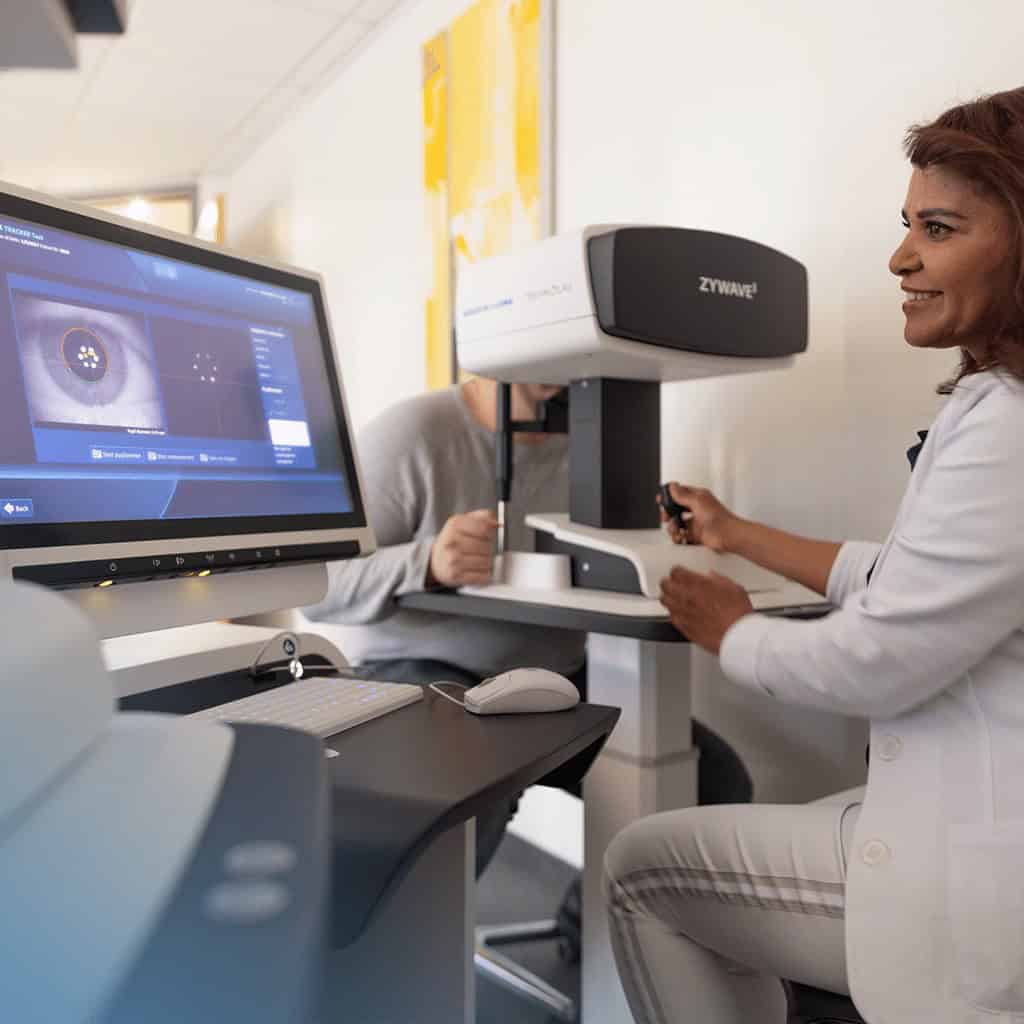
Benefits of Femto-LASIK and Risks of ReLEx SMILE
Femto-LASIK is the next generation of classic LASIK. The additional femtosecond laser creates the necessary flap with extreme precision and without a scalpel. As the gold standard in refractive surgery, Femto-LASIK offers new advantages over LASIK, such as a particularly gentle procedure, even greater precision, and suitability for individual eyes.
Innovative technologies that enable precise vision correction allow you to fully enjoy your leisure activities such as reading, traveling and sports. These lenses are designed to follow the natural movements of the eye and offer a customized solution for your vision needs.
Femto-LASIK
- gentle procedure under local anesthesia
- extremely precise
- No blade required: the femtosecond laser works without contact.
- Corrective correction possible using the same method
- Solution for a variety of visual impairments, even at higher values
- Your individual stray light patterns (aberrations) can also be treated.
ReLEx SMILE
- If the removal of the lenticule does not go smoothly, the corneal surface may remain significantly distorted.
- Achieving optimal visual acuity may take more time than with LASIK.
- A subsequent correction using the same procedure is not possible. It can then only be treated with LASIK, Femto-LASIK or PRK.
- Head movements or pinching by the patient can cause a loss of pressure, which can lead to the procedure having to be aborted and not being able to be continued/repeated in this way.
- The costs for laser eye surgery with SMILE are considerably higher than for LASIK and Femto-LASIK.
- The process is still relatively new,
- Long-term experience is only limited.
- Stray light (aberrations) remains uncorrected.
- SMILE is not suitable for farsightedness.